
Pier fishing puts you directly over deep water, structure, and fish — without a boat, without a license in many cases, and with bait shops and restrooms right there on the pier. It's the most beginner-friendly form of saltwater fishing, and it produces genuinely excellent catches. Species like flounder, pompano, Spanish mackerel, striped bass, bluefish, sheepshead, and even cobia are all regularly caught from public fishing piers up and down the coast.
License note: Many public fishing piers sell pier-specific day licenses at the entrance, or include a pier fishing license in the access fee. Always check with staff before setting up — regulations vary by state and by pier.
Rod for Pier Fishing
Pier fishing doesn't require the 10–12 ft surf rods used on open beaches. You're already elevated above the water — a 7–9 ft medium-heavy rod is ideal. Long enough to reach past the railing and keep line off the pilings, powerful enough to haul larger fish up to pier level, and comfortable to cast all day.
The key spec: medium-heavy power, fast or moderate-fast action, rated for 15–30 lb line. This handles everything from a 1 lb flounder to a 30 lb striper without breaking a sweat.

Penn Battle IV Spinning Combo
The best value saltwater combo for pier fishing at any experience level. Full metal body, sealed drag, and HT-100 carbon fiber drag washers hold up to repeated saltwater exposure and hard-running pier fish. Get the 3000 or 4000 series for standard pier fishing — upgrade to 5000 if you're targeting large pelagics like kings or cobia from the end of an ocean pier.
- Full metal body prevents flex under load from large fish
- HT-100 carbon fiber drag — same spec as Penn's premium reels
- 6+1 sealed bearings for salt-resistant, smooth operation
- CNC gear technology for precise mesh under heavy load
Reel and Line Setup
For pier fishing, run 20 lb braided line with a 24–30 inch fluorocarbon leader of 25–30 lb. Braid packs more line on the reel (important if a fish runs toward a piling), casts farther with less effort, and transmits bites through the line immediately. The fluoro leader handles contact with pilings, dock cleats, and fish teeth without fraying.
If you're specifically targeting larger species — king mackerel, cobia, large stripers — size up to 30 lb braid with 40–50 lb fluoro leader.
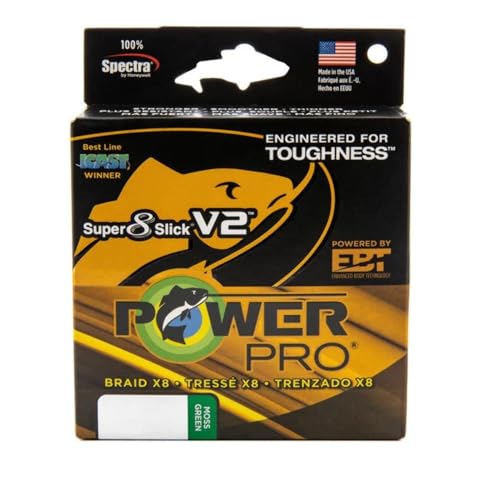
PowerPro Super 8 Slick V2 — 20 lb
The 8-strand construction gives a rounder, smoother profile that casts farther and develops fewer wind knots than standard 4-strand braid. Zero stretch means you'll feel every tick of a flounder picking up a shrimp from 40 feet down at the end of a pier.
- 8-strand weave for longer casts and smoother retrieves
- Zero stretch — bite detection from any depth
- Thin diameter packs more capacity onto the reel
Terminal Tackle for Pier Fishing
Keep your terminal tackle simple. Here's what to have in your pier tackle box:
- Circle hooks, 1/0–4/0 — 1/0–2/0 for flounder, whiting, spot and croaker; 3/0–4/0 for pompano, bluefish, and stripers
- Pyramid sinkers or bank sinkers, 1–3 oz assorted — pyramid holds in current and sandy bottoms; bank sinkers for calmer conditions
- Barrel swivels, size 1–3, pack of 20 — prevents line twist from current and bait spin
- Fluorocarbon leader, 20–30 lb, 30-yard spool — tie a fresh leader every session
- Sabiki rigs — multi-hook rigs with tiny flashy flies for catching bait fish right off the pier
Best Pier Fishing Rigs
Hi-Lo Rig (Double Drop)
The most popular pier rig in existence. Two hooks tied at different heights on a single leader, with a sinker at the bottom. The upper hook targets midwater species; the lower hook fishes near the bottom. Doubles your shot at a bite and covers two depth zones simultaneously. Works especially well for flounder, whiting, spot, croaker, and pompano. Pre-made hi-lo rigs are sold at virtually every coastal bait shop — grab a pack and save yourself rigging time.
Fish-Finder Rig (Single Hook Bottom)
A sinker slides freely on the main line above a barrel swivel, connected to an 18–24" fluoro leader and a single circle hook. The sinker stays on the bottom; when a fish picks up the bait and runs, it feels no resistance and keeps moving — the hook sets in the corner of the mouth as the line comes tight. Best for larger species like stripers, redfish, and big pompano.
Sabiki Rig (Catching Your Own Bait)
A multi-hook rig with 4–8 tiny hooks dressed with flashy tinsel or skin. Drop it vertically from the pier and jig it up and down — you'll catch sardines, cigar minnows, spot, and pinfish to use as live bait. This is the best way to upgrade from shrimp to premium live bait without paying bait shop prices. Search "Sabiki Rig Saltwater Fishing" on Amazon to find the right size for your target bait fish.
Float Rig (Midwater Presentations)
A slip float above a leader ending in a jig head with a shrimp imitation or live bait. Keeps the bait suspended at a specific depth. Best when fish are holding at mid-column rather than the bottom — common in summer when warm bottom water drives fish higher. Effective for bluefish and Spanish mackerel when they're in a chasing mood.
Best Bait for Pier Fishing
Fresh shrimp — Works for every species that swims under a pier. The pier bait shop almost always has it. Hook through the tail, use a 1/0–2/0 circle hook, and fish on any rig. Always fresh over frozen — frozen shrimp disintegrates quickly in current.
Squid — Durable, effective, and stays on the hook better than shrimp in strong tidal current. Cut into 1–3 inch strips or use whole small squid for larger species. A top bait for bluefish and a consistent producer for flounder, stripers, and most pier species.
Cut mullet or menhaden — For larger predators. A fresh 2–3 inch chunk on a fish-finder rig soaking near a piling catches big stripers, red drum, and cobia that patrol pier structure.
Live bait (cigar minnows, pinfish, spot) — The premium option for large pelagics like cobia and king mackerel. Catch your own with a Sabiki rig or buy from the pier bait shop. Hook through the back above the spine and fish on a float or free-lined from the pier end.
Sand fleas — Unbeatable for pompano on southern piers. Collect them along the beach before walking out to the pier, or buy them at the bait counter. Thread 2–3 on a 1/0 circle hook.
Where to Stand on the Pier
Location on the pier matters. The fish aren't evenly distributed — they're stacked in specific places based on current, structure, and depth:
The far end — Deepest water, strongest current, most species variety. King mackerel, cobia, and large bluefish spend most of their time here. If you're comfortable rigging and don't mind the walk, the end of the pier almost always produces bigger and more varied fish.
Near the pilings — Sheepshead, black drum, and flounder hold tight to the pilings. Cast directly against the pilings and let your bait sink straight down. You're fishing structure, not open water.
Upwind/upcurrent corner — Position yourself where the current flows along the length of the pier. Cast upstream and let your bait drift naturally past the pilings — this is the natural direction bait fish move, and predators hold facing into the current waiting for them.
Bait tanks and fish-cleaning stations — These areas attract bait fish (scent in the water) which attract predators. Positioning near them, especially early in the morning when the tank overflow is fresh, often produces bites faster than random positions along the railing.
Retrieve the right way: When a fish picks up bait and runs, don't jerk the rod. With circle hooks, just reel down slowly until you feel weight, then keep steady pressure. The circle hook will slide to the corner of the mouth and set itself. A premature jerk pulls the hook out of the fish's mouth.
Pier Fishing by Region
| Region | Top Species | Best Season |
|---|---|---|
| Northeast (NJ, NY, MA) | Striped bass, bluefish, weakfish | Spring & Fall |
| Mid-Atlantic (MD, VA, NC) | Flounder, drum, pompano, Spanish mac | May–October |
| Southeast (SC, GA, FL) | Sheepshead, Spanish mackerel, cobia | Year-round |
| Gulf Coast (FL, AL, MS, TX) | Redfish, speckled trout, flounder | Year-round |
Pier Etiquette
Piers concentrate anglers in a small space. Courtesy makes the experience better for everyone:
- Don't cross other lines — if you need to walk past an angler who is actively fishing, ask them first
- Call out "Fish on!" when you hook up — nearby anglers reel in to clear space
- Give space — a minimum of 10 feet between setups avoids tangled lines
- Clean up bait scraps — bait left on the pier stinks and draws pests; toss it over the railing
- Don't cast over other anglers' lines — choose your position and cast parallel to your spot


