
Ancarrow's Landing is where the James River stops being a rocky smallmouth river and turns into a wide, tidal, brackish waterway that eventually empties into the Chesapeake Bay. It's the closest boat access to the tidal James from downtown Richmond, and it opens up one of the best trophy blue catfish fisheries in the entire United States. If you've never fished the tidal James — even as a Richmond local — this is your entry point.
This guide covers everything you need to fish Ancarrow's Landing effectively — access, the target species, tackle, rigs, timing, and safety. Written specifically for the tidal James downstream of the fall line, where different rules and different techniques apply than in the rocky sections upstream.
Quick answer: Launch at Ancarrow's off Brander Street in south Richmond, run down to the deep channel bends, and fish fresh cut gizzard shad on the bottom with a Carolina rig for trophy blue catfish. Best months for blues are May–October. Best month for spring stripers is April. A combined VA freshwater + saltwater license is required.
Where Is Ancarrow's Landing?
Ancarrow's Landing sits on the south bank of the James River in south Richmond, just downstream of the Manchester Bridge and the fall line rapids. Access is off Brander Street via Maury Street off Interstate 95. It's part of the James River Park System and operated by the City of Richmond.
The launch has a paved boat ramp, a floating dock, a large gravel parking lot for trailers, and shoreline access along a section of the riverbank. It's the primary public boat launch for the entire tidal James River section that runs from Richmond down through Hopewell and eventually to the Chesapeake Bay.
From the ramp, run downstream to reach the deeper channel bends and prime blue catfish water. The best fishing water is generally within 5–10 miles of the launch.
What You Can Catch at Ancarrow's Landing
The tidal James at Ancarrow's holds a completely different species mix than the rocky non-tidal river upstream. This is fresh-to-brackish water with a wide-open channel — very different fishing.
| Species | Best Season | Best Technique | Typical Size |
|---|---|---|---|
| Blue catfish | May–Oct | Cut bait on bottom | 5–40 lbs (up to 100+) |
| Channel catfish | Year-round | Chicken liver, cut bait | 1–8 lbs |
| Striped bass | Apr–May, Oct–Nov | Live bait, bucktails, live shad | 5–30 lbs |
| Largemouth bass | Apr–Jun, Sep–Oct | Texas rigs, spinnerbaits, swim jigs | 1–6 lbs |
| White perch | Apr–Oct | Small jigs, minnows, bloodworms | 6–14" |
| Bowfin | Apr–Oct | Live bait, big soft plastics | 3–15 lbs |
| Longnose gar | May–Sep | Live minnows, rope lures | 3–20 lbs |
| American shad | Mar–Apr | Shad darts, spoons | 1–3 lbs |
Trophy Blue Catfish: The Main Event
The tidal James River is one of the best trophy blue catfish fisheries in the country. Blue cats over 100 lbs have been caught in this river, and 30–60 lb fish are landed on a regular basis. Ancarrow's Landing is the primary launch for anglers targeting these fish, and if you're a serious catfisherman living within an hour of Richmond, this is your home water.
Map of Ancarrow's Landing
The map below shows the four areas worth your time at Ancarrow's, plus the ramp and parking.
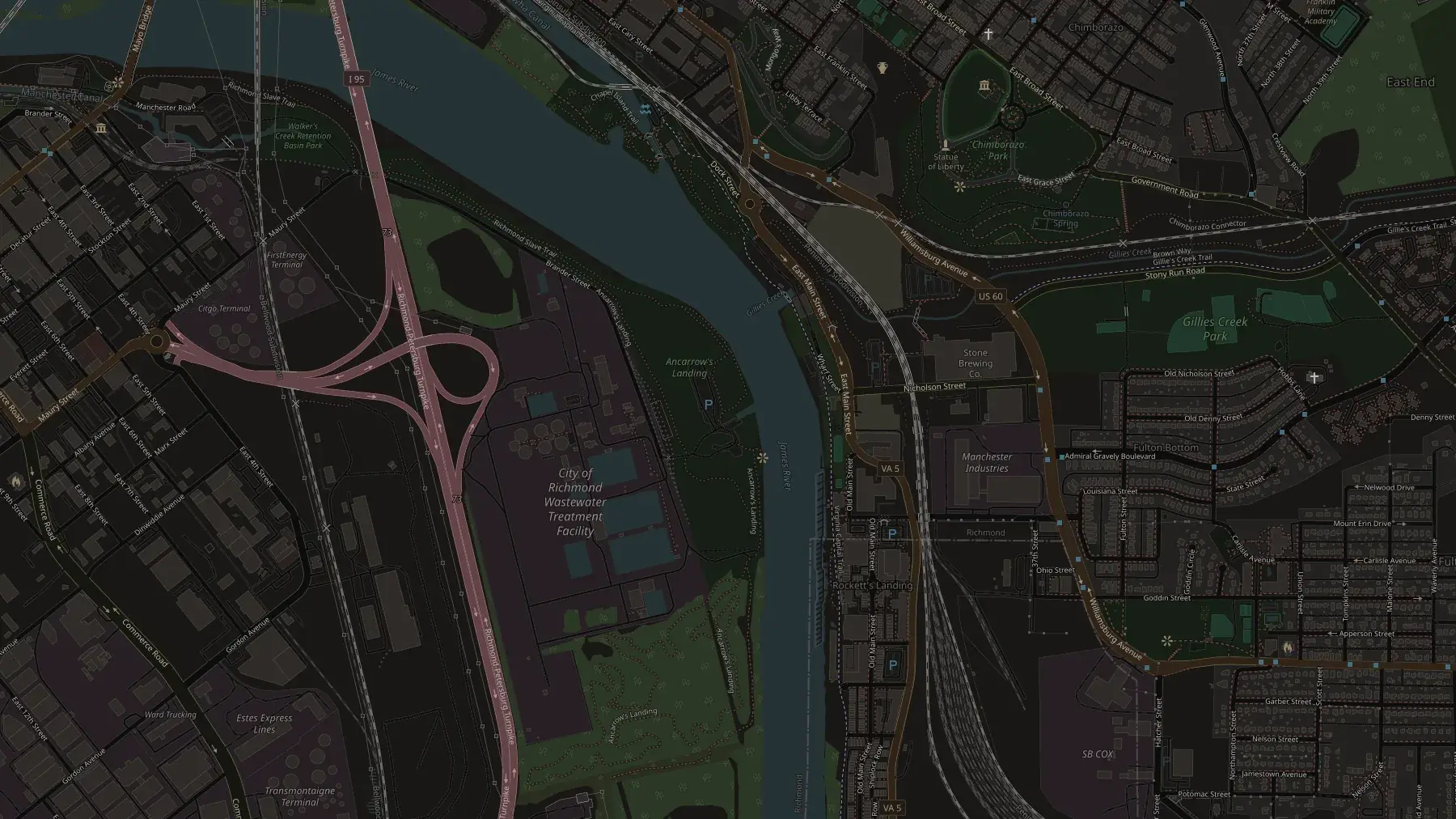
- 1Deep channel holes — 30–50+ ft; where trophy blue catfish concentrate
- 2Riprap bank — rock structure you can reach from shore, next to the ramp
- 3Manchester Docks pilings — current breaks and hard structure
- 4Outside-bend dropoff — deep water swinging close to the bank
- PAncarrow's Landing lot and boat ramp, off Brander Street
Ancarrow's Landing is below the fall line, so the water here is tidal — the bite follows moving water, not time of day. Depths shown are approximate. Pin positions are approximate.
Base map © OpenStreetMap contributors, used under the ODbL. Numbered pins added by HookWake.
Where to Find Blue Catfish
Blue cats hold in the deepest available water — main channel edges, deep holes on outside bends, and structure like dropoffs and pilings. Below Ancarrow's you'll find several holes 30–50+ feet deep along the channel that consistently produce large fish. A quality sonar unit helps enormously here — you're looking for concentrations of fish suspending near bottom.
Best Bait for Blue Catfish
Fresh cut gizzard shad is the gold standard. White perch, small bluegill (if legally kept as bait), and menhaden also work well. The key word is "fresh" — bait that was alive that morning outfishes frozen bait dramatically. Catch or buy shad the day of your trip and keep it iced.
Rig and Tackle
The standard tidal James blue catfish rig is a Carolina rig with an 6–10 oz no-roll sinker, a barrel swivel, an 18–24" leader of 60–100 lb monofilament, and a 8/0 to 10/0 circle hook. Fish it on a 7'6" to 8' heavy-power rod with 80 lb braid. When a big blue picks up the bait, do not swing — the circle hook works itself into the corner of the mouth as the fish pulls against a tight line. Just reel down and lift steadily.
When to Fish for Blues
May through October is the strongest window. Warm water (65°F+) has blues actively feeding. Winter still produces but requires slower presentations in the deepest holes. Nighttime fishing during summer produces some of the biggest fish of the year — blues feed heavily after dark.
Tide matters. Blue cats bite best during moving water. The last two hours of an outgoing tide and the first two of an incoming are the most productive windows. Slack tide often shuts down the bite. Check the tide chart for Richmond before choosing a trip time.
Spring Striper Fishing at Ancarrow's
From April through early May, striped bass push upriver from the Chesapeake Bay through the tidal James on their spawning migration. Ancarrow's Landing sits near the upper limit of striper range — the fall line rapids just upstream stop most migrating fish here. That concentration makes April one of the most productive striper months anywhere on the tidal James.
The most consistent striper technique is fishing live bait (live gizzard shad or herring) on a fish-finder rig near the deep channel edges. Casting bucktails and swim shads in the same water also produces. Best action is often mid-morning through afternoon as water warms.
Note: Virginia striped bass regulations in the tidal James are strict during the spring spawn — check current VMRC regulations before harvesting any fish. Spawning stripers are often catch-and-release only during specific windows.
Largemouth Bass in the Tidal James
The tidal James holds excellent largemouth bass fishing that Richmond anglers routinely overlook. Bass position on the outside bends, along cypress trees, in creek mouths, and around any current-breaking structure. Fish the falling tide — as water drops, bass push toward the main channel and concentrate on the edges where prey gets flushed out.
Texas-rigged creature baits, swim jigs, and Chatterbaits are the most productive lures. Match the tide with your speed — slower on the drop, faster as water starts moving in again.
Recommended Gear for Ancarrow's Landing
The tidal James at Ancarrow's demands heavier tackle than the upstream rocky river. Blue catfish over 40 lbs are common, and you don't want to be under-gunned when one picks up your bait.
Blue catfish setup: 7'6" to 8' heavy-power catfish rod, high-capacity spinning or conventional reel with 80 lb braid, 60–100 lb leader, 8/0–10/0 circle hooks, 6–10 oz no-roll sinkers.
Striper setup: 7' medium-heavy rod, 4000-size reel, 30 lb braid with 40 lb fluorocarbon leader, bucktails and swim shads in the 3/4 to 1 oz range.
Largemouth setup: 7' medium-heavy baitcasting combo, 40–50 lb braid with 15–20 lb fluorocarbon leader, Texas rigs and swim jigs.
Sonar unit: A basic sonar/fishfinder makes an enormous difference on the tidal James for finding the deep holes and structure that hold blue catfish. Not required but strongly recommended.

Ugly Stik GX2 Spinning Combo — 7' Medium
If you're combining bass fishing with occasional catfish and striper trips out of Ancarrow's, the Ugly Stik GX2 in 7' medium is a solid all-around choice for the bass side. Handles Texas rigs, swim jigs, and Chatterbaits for tidal largemouth. Pair with a heavier dedicated catfish rod for serious blue catfish trips.
- Solid bass rod for the tidal James
- Durable enough for boat storage abuse
- Priced well under most alternatives
- Good as a backup rod on multi-species trips
Understanding the Tidal James at Ancarrow's
The tidal James at Ancarrow's has a real tide — roughly 2–4 feet of rise and fall daily. Understanding how to fish it separates good tidal anglers from bad ones. A few key concepts:
Current beats slack. Whether the tide is coming in or going out, moving water triggers feeding. Slack tide (the 30–60 minute window between tides) typically shuts down the bite for most species.
Falling tide concentrates fish. As the tide drops, water drains out of creeks, backwaters, and shallow flats. Predators stack up on the outside of these drain points to ambush prey being pulled out with the falling water. Position yourself where the water is exiting a productive area.
Rising tide spreads fish out. As the tide comes back in, water floods back into the same areas. Fish follow and disperse across shallow flats, cover, and structure. Cover water more actively during the rising tide.
Tidal James water is often muddy. The tidal section of the James carries silt down from the piedmont and gets pushed around by the tides. Water clarity is usually poor to fair. Use larger profiles and more vibration than you would in clear water — Chatterbaits, spinnerbaits, and dark-colored soft plastics work best.
License and Regulations
Ancarrow's Landing is downstream of the fall line, so a combined Virginia freshwater + saltwater fishing license is required for all anglers 16 and older. A freshwater-only license is not sufficient here. Buy your license before you launch — this is a commonly missed detail that draws citations from VMRC officers.
Blue catfish are considered an invasive species in most Virginia tidal waters and can typically be harvested without daily limit — but check current Virginia DWR and VMRC regulations before assuming, as rules can change. Striped bass regulations are strict and change annually — check current rules before any trip.
Consumption advisories exist for the tidal James River due to legacy contamination. Consult the Virginia Department of Health guidelines before eating any fish from these waters, especially larger catfish.
Safety on the Tidal James
The tidal James near Ancarrow's is a working river — commercial vessels, tugboats, and barges use it daily. Stay well clear of the main navigation channel when large vessels are present. Their wakes are enormous and dangerous to small boats.
The current at Ancarrow's can be strong, especially on outgoing tide combined with river flow. Do not swim, wade, or step off your boat here. Wear a PFD any time you're on the water. Weather changes can be sudden — check forecasts and get off the water at the first sign of thunderstorms.
Local Tips
Bring or catch bait fresh. Blue catfish are extremely bait-quality sensitive. Frozen shad from last season will produce a few fish, but fresh cut bait produces dramatically more. Cast-net shad at the launch, or stop at a bait shop that carries fresh bait.
Use circle hooks for catfish. Not just for hookup rate, but also because they hook fish in the corner of the mouth and drastically reduce mortality on released catfish. The VMRC increasingly requires circle hooks in certain fisheries — check current rules.
Fish deep in summer. The tidal James stratifies in summer, with cooler and better-oxygenated water in the deeper channels. Fish deeper than you think, especially in July and August.
Skip trips right after heavy rain. When the piedmont dumps runoff into the James, the tidal section gets muddy and full of debris for several days. Wait for the water to clear.
Watch the wind. An outgoing tide against a strong upriver wind creates a nasty short chop that will beat you up in a small boat. Check wind forecasts and match your trip to a favorable wind-vs-tide combination.
Frequently Asked Questions
Can I bank fish at Ancarrow's Landing?
Some shoreline access exists near the launch. Bank fishing produces channel catfish, small blues, white perch, and occasional largemouth. For serious blue catfish and stripers, a boat or kayak is essentially required.
What's the biggest blue catfish caught at Ancarrow's?
Blue catfish over 100 lbs have been landed from the tidal James River. Fish in the 50–70 lb range are caught every season by anglers targeting them specifically. The current Virginia state record blue catfish came from this river system.
Is Ancarrow's Landing good for kayak fishing?
Yes, but with important caveats. The tidal James has commercial boat traffic, strong current, and cold water most of the year. Kayak anglers should be experienced, always wear PFDs, and stay near the shoreline in the small creek arms rather than the main channel. Winter kayak trips are not recommended.
Can I catch largemouth bass at Ancarrow's?
Yes. Tidal James largemouth fishing is often overlooked but produces well from April through October. Fish the outside bends and creek mouths on the falling tide. See our bass fishing techniques guide for more on tactics.
Are there stripers at Ancarrow's in fall?
Yes, a fall striper run typically pushes into the upper tidal James in October and November as stripers follow bait upriver. Not as concentrated as the spring run but produces quality fish.
What's the difference between Ancarrow's Landing and Osborne Landing?
Both are tidal James River launches. Osborne Landing is farther downstream near Henrico/Chesterfield County line and gives access to the wider tidal section. Ancarrow's is closer to downtown Richmond and gives faster access to the upper tidal section near the fall line.
The Bottom Line
Ancarrow's Landing is the gateway to some of the best trophy blue catfish fishing in the country and the closest tidal-water fishing to downtown Richmond. It's not a beginner's spot — this is deeper water, heavier tackle, and a different set of skills than the rocky upper James — but for anglers who want to chase 40+ lb catfish, spring stripers, and tidal largemouth without driving to the coast, this is the place. Start with a heavy catfish setup and fresh cut shad on the moving tide, learn a few of the deep channel bends downstream, and give the fishery a full season before judging it. The rewards on this water are as big as anywhere in Virginia.
For more Richmond-area fishing content, see our complete Richmond fishing spots guide, our James River smallmouth guide, and our Chickahominy River guide.


