
Pony Pasture Rapids is the best place in Richmond to learn how to fish the James River. It's a wide gravel beach, a stretch of readable rocky shoreline, and enough safe wading water to let you cast into productive current seams without a boat. If you're new to the James — or new to river fishing altogether — this is where you start.
This guide covers everything you need to fish Pony Pasture productively — how to get there, where to fish along the shoreline, what to throw, what to bring, and how to stay safe. Written for the actual first-trip angler, not the tournament-level river rat.
Quick answer: Park at 7310 Riverside Drive, walk down to the gravel beach, and cast a 1/8 oz green pumpkin tube jig into the current seams around the mid-river boulders. Wade only in ankle-to-knee-deep water near the bank. Best months are April–June and September–October. Virginia freshwater fishing license required.
Where Is Pony Pasture Rapids?
Pony Pasture Rapids sits off Riverside Drive in the Westover Hills neighborhood on the south bank of the James River, about a 15-minute drive from downtown Richmond. The main parking area is at 7310 Riverside Drive. It's part of the James River Park System and access is free.
From the parking lot, a short packed-dirt path (about 200 feet) drops down to a wide gravel beach along the river. Once you're at the water, you can walk along the shoreline in both directions — upstream toward Reedy Creek and downstream toward the wilder rocky sections closer to the city. Most fishing happens within a few hundred yards of the beach.
What Can You Catch at Pony Pasture?
Pony Pasture holds a good variety of James River species, dominated by smallmouth bass and rock bass. Below is what you can realistically expect to catch on a typical trip.
| Species | How Common | Best Season | Typical Size |
|---|---|---|---|
| Smallmouth bass | Very common | Apr–Jun, Sep–Oct | 8–15", occasional 18"+ |
| Rock bass | Very common | Apr–Oct | 6–10" |
| Redbreast sunfish | Very common | Apr–Oct | 4–8" |
| Channel catfish | Common | Year-round | 1–5 lbs |
| Bluegill | Common | Apr–Oct | 4–8" |
| American shad | Seasonal (Apr) | Mid Mar–Apr | 1–3 lbs |
| Striped bass | Rare | Apr–May | 5–20+ lbs |
| Flathead catfish | Rare | Summer | 10–40 lbs |
Where to Fish at Pony Pasture
The productive water at Pony Pasture is easier to find than at most James River spots — you can see almost all of it from the beach. The four zones below are where fish concentrate.
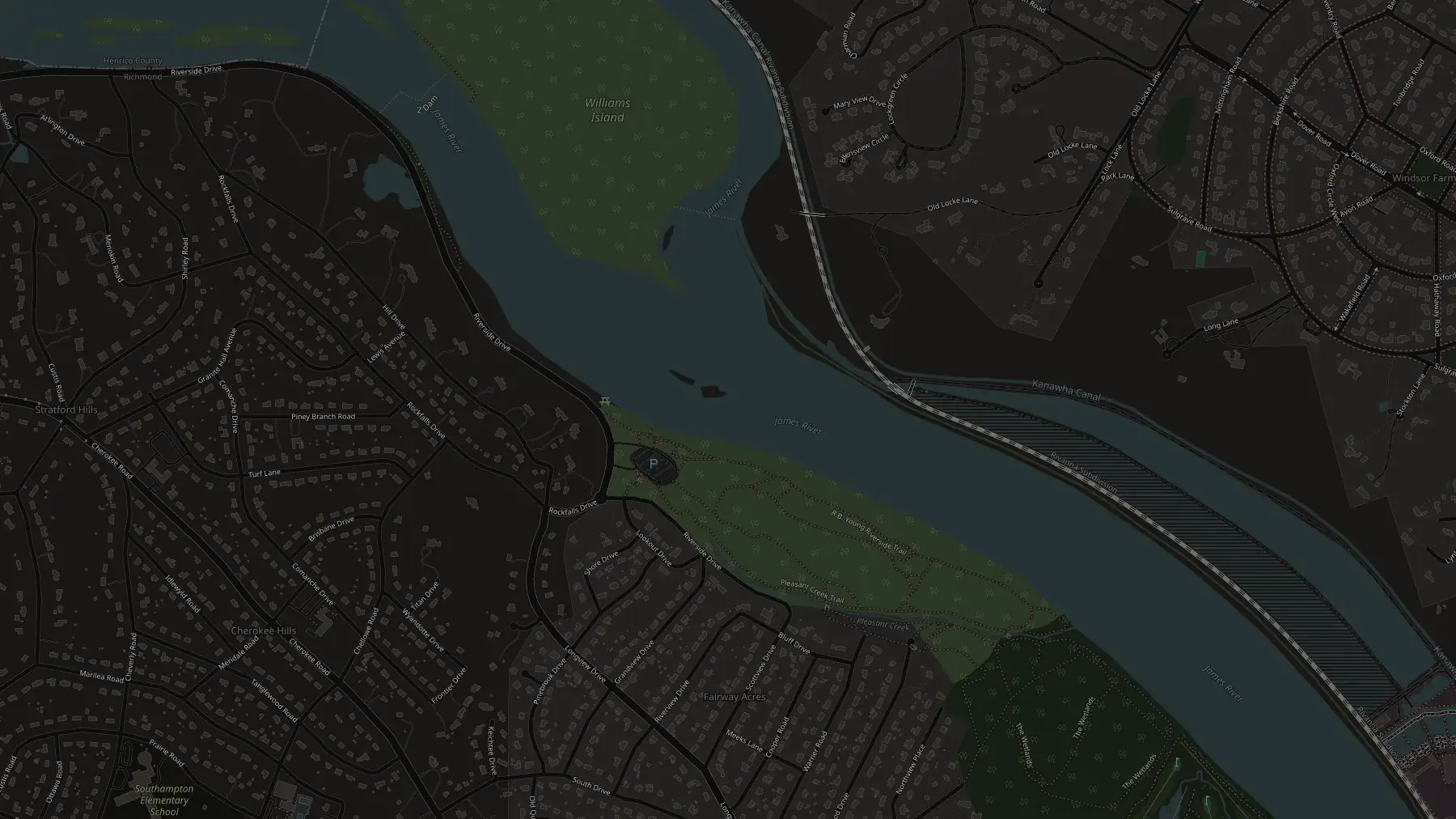
- 1Mid-river boulders — cast upstream of each rock and let the bait drift into the slack water behind it
- 2Beach current seams — wade ankle-deep and cast parallel to the shoreline along the seam
- 3Downstream rock fields — pitch a tube jig into the pockets between rocks; expect bites on the fall
- 4Deeper pools — a jerkbait or slow paddle tail worked at mid-depth
- PParking at 7310 Riverside Drive, then a ~200 ft path down to the gravel beach
The four productive zones at Pony Pasture, all reachable on foot from the Riverside Drive lot. Downstream is to the right — the Class III–IV rapids below the park are not wadeable. Pin positions are approximate.
Base map © OpenStreetMap contributors, used under the ODbL. Numbered pins added by HookWake.
1. The Mid-River Boulders
Look out at the river from the gravel beach and you'll see several large boulders sitting above the surface 30–60 yards from shore. Each of these creates a current break and holds smallmouth. Cast just upstream of the boulder and let your bait drift down and into the slack water directly behind it. Tube jigs, small swimbaits, and Ned rigs all produce.
2. The Current Seams Along the Beach
Directly in front of the gravel beach the current runs at moderate speed with visible seams between fast water and slow water along the shoreline. Wade in ankle-deep water and cast parallel to the shoreline, working your bait along the seam. Smallmouth patrol these seams looking for prey drifting past.
3. The Downstream Rock Fields
Walk downstream from the beach and you'll hit sections of rocky shoreline with pockets, ledges, and small pools. This water is more technical to fish and holds better-quality smallmouth. Pitch a tube jig into pockets between rocks and let it sink. Expect bites on the fall.
4. The Deeper Pools
Between rocky shallow sections you'll find deeper pools with slower current and dark water. These hold larger smallmouth and occasional catfish. A jerkbait or slow-swum paddle tail worked through the pool at medium depth produces best.
How to Wade Pony Pasture Safely
Wading is what makes Pony Pasture such a good spot for beginners — you can reach productive water without a boat. But the James River deserves respect. Here's how to do it safely.
Water level first. Check the USGS gauge for the James River at Richmond (Locks) before every trip. Below 4 ft is ideal wading water. Above 5 ft, wading gets dangerous quickly. Above 6 ft, don't wade at all.
Stay shallow. Wade only in water up to your knees. Above that, the current has enough force to sweep you off your feet, especially where the bottom is uneven. The productive current seams are within casting distance of ankle-deep water — you don't need to wade deep to reach them.
Wear grippy boots. Wading boots with felt or rubber soles are non-negotiable. The James River rocks are covered in algae that is genuinely as slippery as ice. Regular hiking boots slip. Sneakers slip badly. Sandals are a fast trip to the ER.
Move slowly, shuffle your feet. Slide your feet along the bottom instead of picking them up. This prevents you from stepping onto a slippery rock you didn't see and losing your balance.
Never wade downstream of the main beach. The rapids get more serious as you move downstream toward downtown. Stay in the wide, calm section directly in front of the main parking area.
The one rule that matters: If you fall in and get swept downstream, do not try to stand up. Point your feet downstream, keep them at the surface, and swim toward the nearest bank at an angle. Standing up in current is how people drown — feet get pinned between rocks. This is the single most important piece of safety knowledge for anyone fishing the James.
Best Lures for Pony Pasture
A small selection of lures covers almost every situation at Pony Pasture. Don't bring a giant tackle box — you're going to be moving around and hopping between casting positions.
Tube Jig, 1/8 oz Green Pumpkin
The single best lure for Pony Pasture. Rig on a 1/8 oz jighead and drag along bottom through current seams. This lure has caught more smallmouth on the James than everything else combined. Bring at least six of them — you will lose some to rocks.
Paddle Tail Swimbait, 3.5"
A Keitech Fat Swing Impact or Zman DieZel MinnowZ on a 1/4 oz jighead. Cast across current, retrieve steadily just above bottom. Great for covering water when you're trying to find active fish.
Small Jerkbait
A Rapala X-Rap in a shad pattern. Works especially well in cooler water (March, April, October) when smallmouth are less active but will still hit a reaction bait. Cast across current, twitch-pause-twitch.
Popper or Walking Bait
A Rebel Pop-R or Heddon Zara Spook Jr. Worked at first light and last light in summer, topwater produces some of the most exciting strikes you'll ever get on the James.
Live Bait Setup for Panfish
If you're bringing kids or just want to catch numbers of rock bass and sunfish, a size 8 Aberdeen hook with a piece of nightcrawler and a small split-shot works consistently. Cast near the bank rocks and let it drift.
Recommended Gear
The gear list below is intentionally minimal. Everything below fits in a small hip pack or a shoulder sling.
- Rod & reel: 6'10"–7' medium spinning combo, 2500-size reel
- Line: 10 lb braid with 8 lb fluorocarbon leader (or 8 lb monofilament if you're a beginner)
- Tackle: Bag of tubes, a few paddle tails, one jerkbait, one topwater, a handful of jigheads (1/8 and 1/4 oz)
- Wading boots with felt or rubber soles (essential)
- Polarized sunglasses — you need to see structure through the surface glare
- Water and snacks — no vendors at the park
- Small towel or rag for handling fish and drying hands

Ugly Stik GX2 Spinning Combo — 6'6" or 7' Medium
The Ugly Stik GX2 combo is the go-to setup for Pony Pasture wading. It's tough enough to handle being dropped on rocks, sensitive enough to feel bites in current, and priced low enough that you won't cry if it gets scratched up on your first trip. Spool it with 8 lb monofilament for the simplest possible setup, or 10 lb braid + fluorocarbon leader if you want a slight sensitivity edge.
- Handles every lure in your Pony Pasture box
- Nearly indestructible — perfect for rocky wading
- Priced under $70 complete
- The most common rod on the James for a reason
For more on rod and line selection for smallmouth fishing, see our best beginner bass rod guide and best fishing line for bass.
Rapala X-Rap Jerkbait
The March, April and October bait at Pony Pasture. Cast across the current, twitch-pause, and let the current do the work.
Heddon Zara Spook
First light and last light over the boulder field. The most exciting way to catch a James River smallmouth.
Best Time of Day and Year to Fish Pony Pasture
Time of Day
Early morning (dawn until 9 AM) and evening (5 PM until dark) are the two most productive windows year-round. Midday summer trips are tough — high sun and warm water push smallmouth off the shallow rocks and into deeper cover. On overcast days, fishing can be good all day.
Time of Year
The peak windows are April–June and September–October. April is the best all-around month — water in the mid-60s, active pre-spawn smallmouth, and the possibility of running into a striper or shad on any cast. Summer produces at dawn and dusk. Fall produces well into October before cooling water slows the bite.
| Season | Rating | Best Approach |
|---|---|---|
| Early Spring (Mar) | ★★★ | Jerkbaits, slow tubes in warmer afternoons |
| Spring (Apr–May) | ★★★★★ | Tubes, swimbaits, jerkbaits all day |
| Summer (Jun–Aug) | ★★★ | Topwater dawn/dusk, deep tubes midday |
| Fall (Sep–Oct) | ★★★★★ | Swimbaits, tubes, jerkbaits all day |
| Late Fall (Nov) | ★★★ | Slow jerkbaits, deep tubes on warm afternoons |
| Winter (Dec–Feb) | ★ | Skip most trips; try warm afternoons for occasional fish |
License and Regulations
Pony Pasture is in the non-tidal James, so a Virginia freshwater fishing license is all you need. Anglers 16 and older must have a valid license. Buy online at the Virginia DWR website or in-person at most sporting goods stores. Short-term licenses (1-day and 5-day) are available.
Standard Virginia smallmouth bass and panfish regulations apply. Check current DWR regulations before harvesting fish. Most Pony Pasture anglers practice catch-and-release to protect the fishery.
Local Tips
Arrive early on weekends. Pony Pasture is one of the most popular spots in the James River Park System for both anglers and tubers. Summer weekends the parking lot fills by 10 AM and the river fills with recreational tubers by noon — which shuts down the fishing.
Fish weekdays if you can. A Tuesday morning at Pony Pasture is completely different from a Saturday morning. On weekdays you may have the entire beach and half the river to yourself.
Bring bug spray in summer. Mosquitoes near the water can be aggressive in June and July at dawn and dusk.
Don't try to wade the rapids. The rapids downstream of Pony Pasture are Class III–IV whitewater. Multiple drownings have happened there. Fish the wide, calm section directly in front of the parking area only.
Skip trips after heavy rain. If more than an inch of rain fell within the last 24 hours anywhere from Lynchburg east, the James at Richmond will be high, muddy, and unfishable. Check the gauge and don't waste the trip.
Frequently Asked Questions
Is Pony Pasture free to fish?
Yes. Access to Pony Pasture is free. You do need a Virginia freshwater fishing license if you're 16 or older.
Can I bring my kids to fish at Pony Pasture?
Yes — Pony Pasture is one of the most kid-friendly spots on the James. The gravel beach is safe to play on, and panfish and rock bass will bite worms all day near the bank rocks. Stay out of the current with young children and always have them wear a PFD if they'll be near the water.
Are there bathrooms at Pony Pasture?
Yes, portable toilets are provided in the parking area. No permanent facilities. No drinking water — bring your own.
Can I fly fish at Pony Pasture?
Yes, Pony Pasture is one of the most popular fly-fishing spots on the James. Smallmouth on poppers and streamers is the primary target. See our beginner fly fishing guide to start.
What's the biggest smallmouth caught at Pony Pasture?
Fish over 20 inches (roughly 4+ lbs) are caught every year by anglers who put in the time. The James River smallmouth record is well over 6 lbs, and while fish that size are rare, 15–18 inch smallmouth are realistic targets on any trip when conditions are right.
Do I need a boat or kayak?
No. Pony Pasture is one of the few James River spots that fishes very well from the bank and from wading. A kayak opens up more water but is not required.
The Bottom Line
Pony Pasture Rapids is the best beginner-friendly fishing spot in the entire Richmond area. It's free, easy to reach, safe when you follow basic wading rules, and productive enough that you can catch fish on your first trip if you show up with the right lures and a willingness to learn. Start with a bag of tubes, park at 7310 Riverside Drive, and spend a morning learning to read current seams. You'll be catching smallmouth on the James River before the end of your first season.
For more Richmond-area fishing, see our James River smallmouth bass guide, our Belle Isle fishing guide, and our complete Richmond fishing spots guide.


